The Constantinople Panorama
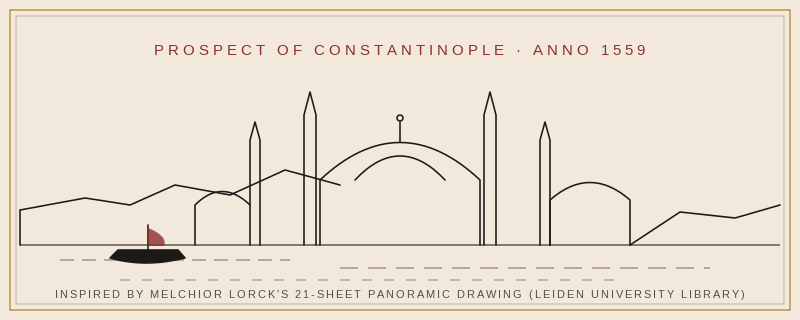
Drawn across twenty-one joined sheets of paper in pen and ink with watercolor wash, Lorck’s sweeping view of the Golden Horn and Ottoman skyline remains an unmatched architectural document of 16th-century Istanbul.
Explore the authoritative digital archive dedicated to Melchior Lorck (c. 1526/27 – after 1583), the Danish-German painter, draughtsman, and engraver whose eyewitness depictions of Constantinople and the Ottoman Empire transformed European visual history.
Lorck bridged Northern European engraving traditions, Italian architectural theory, and firsthand ethnographic observation during one of the most dynamic periods of early modern diplomacy.
Drawn across twenty-one joined sheets of paper in pen and ink with watercolor wash, Lorck’s sweeping view of the Golden Horn and Ottoman skyline remains an unmatched architectural document of 16th-century Istanbul.
Containing 128 intricate woodcuts of sultans, janissaries, diplomats, scholars, and architectural landmarks, Lorck’s graphic series shaped European visual understanding of the Ottoman world for centuries.
Supported by King Christian III of Denmark, Emperor Ferdinand I, and Emperor Maximilian II, Lorck produced portrait engravings, triumphal arches, and hydrographic maps such as his renowned 1568 Elbe River map.
The Melchior Lorck Digital Archive brings together biographical documentation, provenance notes, and curatorial essays to support art historians, architects, students, and cultural institutions worldwide.
Whether you are researching Northern Renaissance printmaking, early modern Habsburg-Ottoman diplomacy, or historical urban topography, our structured index provides clear, verifiable context.
Read Our Vision & Mission“Through relentless precision of line and firsthand travel across courts and seas, Melchior Lorck turned the draughtsman’s pen into a lasting bridge between Northern Europe and the Mediterranean world.”